The Laptop Diet: 10 Steps to Speed Up a Slow Laptop (Windows and Mac)
A slow laptop is one of the most frustrating parts of modern life. It takes minutes to start, the fan roars when you open a browser, and every click seems to need a moment of thought. Before you spend money on a new machine, try a laptop diet: a structured cleanup that removes what slows your computer down, frees storage, trims startup programs, and gets the most from the hardware you already own. In many cases a laptop that feels five years old can feel years younger after an hour or two of focused work.
This guide gives you a complete laptop diet for Windows and Mac. You will learn how to find out what is actually slowing your laptop, clear storage, tame startup apps, fix browser bloat, adjust power and visual settings, check for malware, decide whether to upgrade the RAM or swap to an SSD, and when to reset or replace. Each step is simple and reversible.
Quick answer: how do you speed up a slow laptop?
- Restart and install pending updates.
- Open Task Manager or Activity Monitor to see what is using CPU, memory, and disk.
- Free at least 15 to 20 percent of your storage.
- Disable unneeded startup programs and browser extensions.
- Scan for malware and check your battery and power settings.
- If it is still slow, add RAM or switch to an SSD, or back up and reset.
Step 0: Diagnose Before You Diet
Laptops are slow for different reasons, and the fix depends on the cause. Spend five minutes finding it.
On Windows
- Press Ctrl+Shift+Esc to open Task Manager.
- Click the Processes tab and sort by CPU, Memory, and Disk. Note which programs sit at the top.
- Look at the Performance tab. Memory use constantly above 80 to 90 percent suggests too little RAM. Disk use stuck at 100 percent suggests a slow hard drive or a runaway process.
- Open the Startup tab and sort by startup impact.
On Mac
- Open Activity Monitor from Applications, then Utilities.
- Check the CPU, Memory, and Disk tabs. In the Memory tab, look at the Memory Pressure graph: red means the Mac is short of RAM.
- Look for apps using lots of energy under the Energy tab.
What the symptoms mean
| Symptom | Likely cause | Best first step |
|---|---|---|
| Slow to start and slow to open apps | Too many startup programs; slow hard drive | Trim startup apps; consider an SSD |
| Fine at first, then slows down | Overheating, memory leaks, or too many browser tabs | Clean vents; restart apps; limit tabs |
| Disk at 100 percent | Mechanical hard drive, background updates, or indexing | Wait for updates; check drive health; upgrade to SSD |
| Memory constantly full | Not enough RAM for your workload | Close apps; add RAM if possible |
| Fan loud and laptop hot | Dust, heavy process, or poor ventilation | Clean vents; check for rogue processes; use a hard surface |
| Browser is the slow part | Extensions, many tabs, or cache | Disable extensions; use tab suspension |
| Everything slow after an update | Background indexing or a driver issue | Wait a day; update drivers |
| Sudden slowness and pop-ups | Malware or unwanted software | Run a security scan |
Step 1: Restart, Update and Check for Pending Tasks
It sounds too simple, but a laptop that has run for weeks without a restart often accumulates memory leaks and stuck processes. Restart it, then check for operating system updates, driver updates, and app updates. Updates can fix performance bugs. Be patient after major updates, because the system may spend a while indexing files and reorganizing in the background.
Step 2: Free Up Storage
When a drive is nearly full, performance suffers. Operating systems need free space for temporary files, virtual memory, and updates. Aim to keep at least 15 to 20 percent of your drive free, and on a small SSD even more.
Find the big items
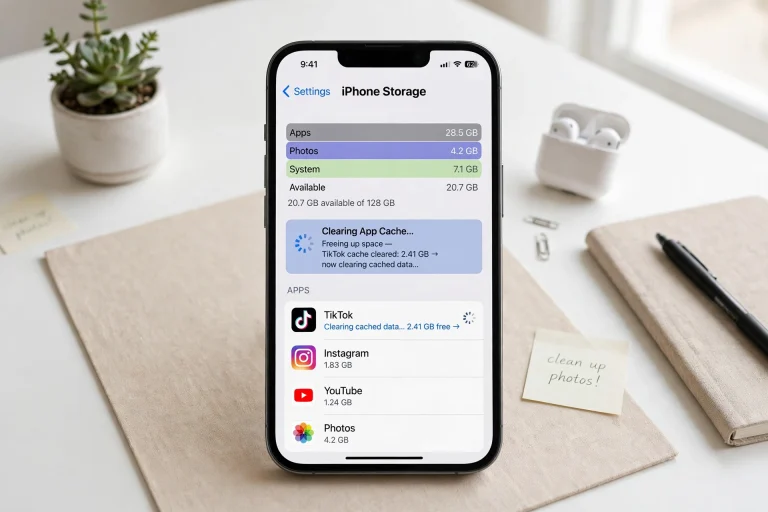
- Windows: open Settings, then System, then Storage to see categories. Use Temporary files and Cleanup recommendations to remove safe items. A free tool such as WinDirStat or TreeSize Free shows which folders are largest.
- Mac: open Apple menu, System Settings, General, Storage. Review recommendations, and check Documents, Applications, and System Data. Tools like GrandPerspective or DaisyDisk show space visually.
What to remove first
| Item | Typical savings | Safe to remove? |
|---|---|---|
| Downloads folder | 1 to 50 GB | Yes, after checking for installers and files you want |
| Old videos and screen recordings | 5 to 100 GB | Yes, after copying to an external drive or cloud |
| Unused apps and games | 2 to 100 GB | Yes, uninstall through the proper settings |
| Temporary files and cache | 1 to 20 GB | Yes, via built-in cleanup tools |
| Recycle Bin or Trash | Varies | Yes, after a quick look |
| Duplicate photos | 1 to 30 GB | Yes, keep one copy of each |
| Old system restore points and update leftovers | 1 to 20 GB | Yes, via built-in cleanup options |
| Phone backups on your laptop | 5 to 100 GB | Only if you have another backup |
For a deeper cleanup of folders, files, and duplicates, follow our guide on how to declutter your computer and the checklist in how to declutter digital files. If you wonder how much space you should aim for, our guide on how much storage you need will help you plan.
Move files, do not just delete them
Large photo and video libraries are better on an external drive or in the cloud. Estimate the transfer time with our file transfer time calculator before starting a big copy.
Step 3: Trim Startup Programs
Every app that launches at startup uses memory and slows down your boot time. Many are not necessary.
Windows
- Open Task Manager and go to the Startup tab (or Settings, Apps, Startup).
- Right-click anything with a high impact that you do not need immediately, such as chat apps, game launchers, and updaters, and choose Disable.
- Do not disable security software, audio drivers, or touchpad drivers.
Mac
- Open System Settings, then General, then Login Items.
- Remove apps that you do not need to open at login using the minus button.
- Also check Allow in the Background and turn off helpers you do not use.
Disabling startup does not uninstall the program, so you can always open it manually.
Step 4: Tame Your Browser
For many people, the browser is the slowest part of the laptop. A hundred tabs, a dozen extensions, and a huge cache add up.
- Close tabs you are not using. Bookmark or save pages for later. Use a tab manager or the built-in tab sleeping and memory saver features offered by modern browsers.
- Remove unused extensions. Each extension uses memory and can read or change page content. Keep only the ones you really use, and download them from official stores.
- Clear cache and cookies occasionally, especially if a particular site is acting strangely.
- Check browser task manager. Most browsers have a built-in task manager that shows which tab or extension is using resources.
- Update the browser. Performance improvements arrive often.
If you are overwhelmed by tabs and messaging distractions, you may also like our guide on Slack and Teams overload.
Step 5: Uninstall Programs You Do Not Use
Apps can include background services, update checkers, and tray icons. Remove what you do not need.
- Windows: Settings, Apps, Installed apps. Sort by size or last used, and uninstall. Watch for trial software and manufacturer bloatware that came with the laptop.
- Mac: open Applications and drag unused apps to the Trash, or use the app’s own uninstaller if it has one. Leftover files in the Library folder are usually small.
Be careful not to remove drivers or system utilities. If you are unsure what something is, search its name first.
Step 6: Check for Malware and Unwanted Software
Unwanted programs, adware, and malware can use CPU and memory, show ads, and slow your browser. Run a scan with your operating system’s built-in security tool, such as Windows Security, and optionally a reputable second-opinion scanner. Remove browser add-ons you do not recognize, and reset the browser if it is hijacked. Never install a “free speed-up” program from a pop-up, since those are often the actual problem. To understand how scams use fake alerts, see our article on the Google storage scam.
Step 7: Adjust Power and Visual Settings
- Power mode: on Windows, set the power mode to Balanced or Best performance when plugged in. On battery, power saver can slow the processor.
- Visual effects: on older laptops, reducing animations and transparency can help. On Windows, look under Settings, Accessibility, Visual effects. On Mac, turn on Reduce Motion and Reduce Transparency in Accessibility.
- Background apps: limit apps that run in the background, especially on battery.
- Battery health: an old or swollen battery can cause throttling or shutdowns. Check battery health in system settings or manufacturer tools.
Step 8: Keep It Cool
Heat makes processors throttle themselves, which makes everything slower. Dust in the vents and fans is a very common cause of slowdowns in laptops that are a few years old.
- Use the laptop on a hard, flat surface, not a bed or sofa.
- Power off and unplug before cleaning. Use compressed air in short bursts on the vents.
- If you are comfortable and your warranty allows it, open the bottom panel and clean the fan. Otherwise, take it to a technician.
- Consider a stand or cooling pad for heavy workloads.
Step 9: Consider Hardware Upgrades
If software changes are not enough, hardware can make a big difference, depending on the model.
| Upgrade | When it helps | Notes |
|---|---|---|
| Replace hard drive with an SSD | Slow boot, slow app opening, disk at 100 percent | The most dramatic upgrade for older laptops with spinning drives |
| Add RAM | Memory constantly full; many tabs and apps | Many newer laptops have soldered RAM that cannot be upgraded; check your model |
| Replace the battery | Short battery life, shutdowns, throttling | Use quality parts or an authorized service |
| Clean fans and reapply thermal paste | Overheating, noisy fan | Best done by a technician unless experienced |
| Use an external SSD | Need more storage or fast backup | Easy and does not need opening the laptop |
Check your laptop’s model number and manufacturer guides to see which parts are replaceable. Many modern thin laptops do not allow upgrades, which makes careful software cleanup even more important.
Step 10: Back Up and Reset if Needed
If the laptop is still slow after the earlier steps, a clean reinstall of the operating system can remove years of accumulated software and settings. Use this as a last resort.
- Back up everything important to an external drive and the cloud, and check that you can open the backups.
- Note your software licenses and account details.
- Use the built-in reset option in Windows (Settings, System, Recovery) or reinstall macOS from recovery mode.
- Reinstall only the apps you need and avoid installing trial software and add-ons.
When to Replace Your Laptop
- It no longer receives security updates from the manufacturer or operating system.
- The cost of repairs and upgrades is close to the price of a new machine.
- It cannot run the programs you need, even after cleanup.
- The battery swells or the hardware is failing.
When you replace, avoid sending old devices to landfill. Wipe them, recycle through an electronics program, or donate if they are still usable. See our guide on your digital carbon footprint to learn how device lifespan affects the environment.
Habits to Keep Your Laptop Fast
| Frequency | Habit |
|---|---|
| Daily | Close unused apps and tabs; shut down or restart when you finish |
| Weekly | Empty the Downloads folder and the Recycle Bin or Trash |
| Monthly | Install updates; review startup items; check storage space |
| Every 3 to 6 months | Uninstall unused apps; review browser extensions; back up |
| Yearly | Clean the vents; check battery health; consider whether upgrades make sense |
Quick 30-Minute Laptop Diet
- 5 minutes: restart, then open Task Manager or Activity Monitor and note the heaviest processes.
- 10 minutes: clear Downloads, Recycle Bin or Trash, and temporary files.
- 5 minutes: disable high-impact startup items.
- 5 minutes: remove unused browser extensions and close extra tabs.
- 5 minutes: run a security scan and check for system updates.
Windows vs Mac: What Is Different?
| Task | Windows | Mac |
|---|---|---|
| See what is using resources | Task Manager (Ctrl+Shift+Esc) | Activity Monitor |
| Manage startup apps | Task Manager, Startup tab | System Settings, General, Login Items |
| Free up storage | Settings, System, Storage | System Settings, General, Storage |
| Check for updates | Settings, Windows Update | System Settings, General, Software Update |
| Security scan | Windows Security | Built-in protections plus a trusted scanner if needed |
| Reset the system | Settings, System, Recovery | Recovery mode reinstall |
Three Real-World Examples
Example 1: A five-year-old laptop with a spinning hard drive
Boot time was nearly four minutes and the disk sat at 100 percent. After trimming startup apps, clearing 40 GB of old downloads, and replacing the hard drive with an inexpensive SSD, boot time dropped to under a minute and apps opened almost instantly. The SSD made the biggest difference.
Example 2: A student laptop with 8 GB of RAM and 60 tabs
Memory use was always near full and the browser kept freezing. Enabling the browser’s memory saver, removing six extensions, and bookmarking tabs into folders cut memory use by about a third. No hardware change was needed.
Example 3: A work laptop that overheated during calls
The fan roared and video calls stuttered. Compressed air cleared a thick layer of dust from the vents, the laptop moved off a soft cushion onto a desk stand, and a background sync app was set to pause during meetings. Temperatures dropped and the calls became smooth again.
Mistakes to Avoid During a Laptop Diet
- Deleting system files or folders you do not recognize.
- Installing registry cleaners or “optimizer” programs from pop-up ads.
- Disabling security software to gain speed.
- Skipping a backup before a reset.
- Opening a laptop without checking the manufacturer’s guidance, which may void a warranty.
- Expecting a miracle from software when the hardware is simply too old.
Key Takeaways
- Diagnose first with Task Manager or Activity Monitor so you fix the real cause.
- Keep 15 to 20 percent of your storage free by clearing downloads, old videos, and unused apps.
- Disable unneeded startup programs and browser extensions for faster boot and smoother browsing.
- Check for malware, keep the laptop cool, and use sensible power settings.
- An SSD or extra RAM can transform an older laptop if your model supports it.
- Back up before any reset, and replace the laptop when updates stop or repairs cost too much.
A laptop diet does not need special tools or technical expertise, just a little time and a willingness to remove what you do not need. Work through the steps in order, test the speed after each one, and stop when it feels good again. Most people find that the biggest gains come from the simplest changes: freeing storage, cutting startup apps, and closing the browser tabs they never meant to keep.
Frequently Asked Questions
Why is my laptop so slow all of a sudden?
Common causes include a nearly full drive, too many startup programs or browser tabs, pending updates running in the background, overheating, or malware. Check Task Manager or Activity Monitor to see what is using CPU, memory, and disk.
How can I speed up my laptop for free?
Restart it, install updates, free up storage, disable unnecessary startup programs, remove unused browser extensions, close extra tabs, uninstall unused apps, and run a malware scan. These steps cost nothing.
How much free space should a laptop have?
Aim for at least 15 to 20 percent of the drive free. Operating systems need space for temporary files, updates, and virtual memory, and performance drops when the drive is nearly full.
Will adding RAM make my laptop faster?
It can, if your memory is constantly full. If Task Manager or Activity Monitor shows memory pressure, extra RAM helps. Check whether your laptop’s RAM is upgradeable first, since many newer models have it soldered.
Is it worth upgrading to an SSD?
Yes, for laptops that still use a spinning hard drive. An SSD usually makes boot time and app launches dramatically faster and is often the best upgrade for an older laptop.
Should I use a PC cleaner or speed-up app?
Usually not. Built-in tools handle storage cleanup and startup management well, and many third-party speed-up apps are unnecessary or even unwanted software. Use trusted tools from official sources only.
How do I stop my laptop from overheating?
Use it on a hard flat surface, clean dust from the vents with compressed air, close heavy background apps, and consider a cooling stand. If it still overheats, have the fan and thermal paste checked.
When should I reset or replace my laptop?
Reset it if it stays slow after cleanup, after backing up your data. Replace it if it no longer gets security updates, repair costs are close to the price of a new one, or it cannot run the programs you need.